Harmonics on the Horizon: The Invisible Wave Pollution Straining America's Grid
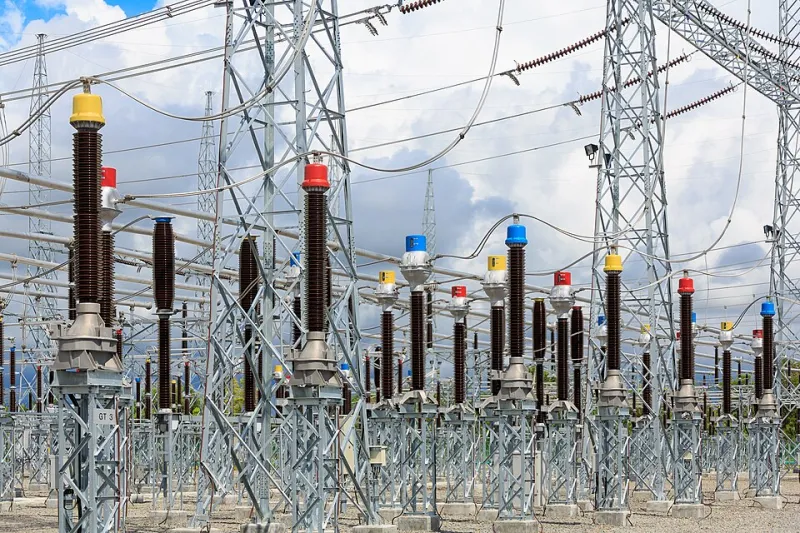
Photo: CEphoto, Uwe Aranas, CC BY-SA 3.0, via Wikimedia Commons
The North American power grid was designed around a single, elegant assumption: electricity arrives as a pristine 60 Hz sine wave. For a century, that assumption held. Today, it is quietly eroding. Every rooftop solar inverter in Arizona, every Level 2 charger in a California garage, and every variable-speed heat pump in a New England suburb injects harmonic distortion—unwanted waveforms riding atop the fundamental frequency—into distribution networks that were never built to absorb them.
What Harmonic Distortion Actually Does
When multiple nonlinear loads draw current in sharp pulses rather than smooth sinusoids, they superimpose higher-order harmonics—multiples of 60 Hz—onto the waveform. Individually, these are negligible. Collectively, they exhibit the same physics that governs any interference phenomenon: waves that align in phase reinforce one another, and waves out of phase cancel.
The trouble is that grid infrastructure responds unevenly across frequencies. Capacitor banks tuned to correct power factor can resonate with grid inductance at a harmonic frequency, amplifying distortion the way a acoustic cavity amplifies a particular note. Utilities have documented transformer overheating, neutral conductor overloading, and nuisance tripping of protective relays—failures that trace directly back to waveform contamination rather than raw power shortage.
The Inverter Problem
Legacy generation—spinning turbines synchronized to the grid—naturally damps distortion. Inverter-based resources do not. Solar arrays and battery storage systems synthesize their alternating current electronically, and cheap switching electronics produce characteristic harmonic signatures. As coal plants retire across the Midwest and PJM's resource mix shifts, the grid is losing the very machines that kept its waveform clean.
This is not an argument against renewables. It is an argument that the grid's interference budget is finite, and we are spending it faster than we are managing it.
Cancellation as Infrastructure
The engineering response borrows from a familiar idea: active noise cancellation, applied at megawatt scale. Active harmonic filters measure the distorted current waveform in real time and inject an equal-and-opposite compensating signal, destructively interfering with the unwanted harmonics while leaving the fundamental 60 Hz component untouched. Deployed at substations and large commercial service entrances, these devices can suppress distortion orders of magnitude faster than passive filters.
Passive solutions still matter. Tuned LC filter banks, deliberately designed to present a low-impedance path at specific harmonic frequencies, divert distortion harmlessly to ground. The most resilient grid architecture layers both: passive filtering for predictable, steady-state harmonics; active cancellation for the dynamic, bursty interference that characterizes modern load profiles.
A Regulatory Blind Spot
IEEE Standard 519 sets limits on harmonic distortion, but enforcement is inconsistent, and the standard was written for a grid dominated by rotating machines. As electrification accelerates—EV adoption targets, heat pump incentives, data center buildouts—the aggregate distortion load will grow regardless of individual device compliance. What is needed is system-level waveform monitoring, treated with the same seriousness as voltage and frequency regulation.
The 60 Hz hum has been the soundtrack of American electrification for over a century. Keeping it clean is no longer automatic. It requires treating interference not as a nuisance, but as a first-class constraint on grid design—measured, budgeted, and actively canceled before it cancels us.