Reverberant by Design: How Open-Plan Offices Became Accidental Interference Chambers—and What Architecture Can Do About It
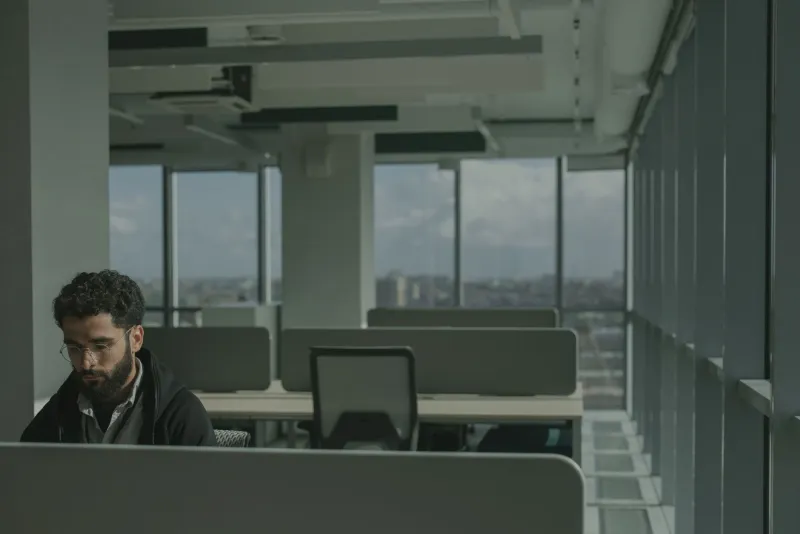
Walk into virtually any technology company headquarters, media organization, or financial services firm in a major American city, and you will encounter the same spatial grammar: rows of unassigned workstations, exposed concrete ceilings, glass-walled conference rooms, and an absence of interior walls that would have been unthinkable in a mid-century corporate environment. The open plan promised transparency, spontaneous collaboration, and efficient use of expensive real estate. What it delivered, in acoustic terms, was something considerably less desirable.
Researchers studying workplace environments have documented with increasing precision what workers have complained about for years: open offices are loud in a specific and cognitively damaging way. The problem is not simply volume. It is the structure of the sound field—a structure that acoustic physics identifies as a constructive interference environment, where reflected sound waves from multiple surfaces arrive at workstations already combined, amplified, and stripped of the directional information that would allow the auditory system to filter them.
How Reflective Surfaces Create an Interference Field
Sound propagates from a source as a pressure wave. In an acoustically treated environment—one with absorptive surfaces, irregular geometries, and spatial differentiation—those waves encounter obstacles that scatter, absorb, and redirect them. The result is a rapid decay of sound energy with distance, a property acoustic engineers describe as a short reverberation time (RT60).
In a typical open-plan office, the acoustic geometry is almost perfectly engineered to prevent this decay. Hard concrete or tile floors reflect sound with minimal absorption. Exposed ceilings—a design aesthetic borrowed from industrial loft spaces—offer no absorptive treatment. Glass partitions, increasingly common as a visual compromise between open and enclosed space, are acoustically transparent and reflective. The geometry of long, rectangular floor plates ensures that reflected waves from distant sources arrive at workstations from multiple angles and with minimal time delay relative to the direct sound.
This configuration produces a well-documented acoustic phenomenon: multiple reflections of the same sound source arriving at a listener's position with different path lengths. When the path-length differences correspond to half-wavelengths of frequencies within the speech range—roughly 300 to 3,400 Hz—the reflected waves arrive out of phase with the direct sound and with earlier reflections. In some frequency bands, this produces destructive interference, creating dips in the frequency response that degrade speech intelligibility. In other bands, where reflections arrive in phase, constructive interference amplifies certain frequencies, producing the characteristic harsh, fatiguing quality that occupants of open offices describe as exhausting rather than merely loud.
The Cognitive Cost of Constructive Noise
The distinction between loud and acoustically complex matters because the auditory cortex and the prefrontal cortex respond to them differently. Research published over the past decade by teams at the University of California, San Francisco, and at Cornell University's Human Factors and Ergonomics Laboratory has demonstrated that irrelevant background speech—particularly speech that is intelligible enough to be partially processed but not fully attended to—imposes a disproportionate cognitive load on working memory.
The mechanism is rooted in what psychologists call the irrelevant speech effect. The auditory system cannot voluntarily suppress the processing of speech-like stimuli in the way it can ignore a steady-state noise like HVAC hum. When a colleague's conversation at an adjacent workstation arrives at a listener's ears with sufficient intelligibility—which in a reverberant environment means with sufficient amplitude across the speech frequency range—the phonological loop in working memory is partially hijacked. Tasks requiring verbal working memory, reading comprehension, and complex reasoning show measurable performance decrements.
The constructive interference dynamics of open offices make this worse in a specific way: by amplifying certain speech frequencies and extending the spatial range over which conversations remain intelligible, they increase the number of competing speech sources that reach any given workstation above the intelligibility threshold simultaneously. The listener's auditory system is presented not with one interfering signal but with several, each partially processed, collectively saturating the cognitive channels that focused work depends upon.
A widely cited study from researchers at the University of Sydney found that over 50 percent of open-plan office workers in the United States and Australia identified noise and lack of speech privacy as their primary workplace dissatisfaction—outranking temperature, air quality, and lighting combined. Subsequent productivity analyses have estimated the cognitive performance penalty at between 5 and 15 percent on tasks requiring sustained attention, with larger deficits observed in workers performing complex analytical or creative work.
Designing Against Constructive Interference
The acoustic physics of the problem points directly toward solutions. If the damaging effects arise from the constructive summation of reflected waves, the design intervention is to prevent those reflections from summing—either by absorbing them before they can propagate, by scattering them so that their phase relationships become incoherent, or by introducing masking signals that raise the ambient noise floor in a controlled way, reducing the intelligibility of competing speech sources without adding to cognitive load.
Absorption is the most straightforward intervention. Acoustic ceiling tiles, suspended baffles, and upholstered furniture reduce the reflective surface area available to redirect sound. The challenge in aesthetically driven office environments is that these treatments are frequently sacrificed for visual reasons—the same exposed concrete ceiling that photographs well in an architectural magazine is an acoustic liability of the first order.
Scattering offers a more design-compatible alternative. Irregular ceiling geometries, bookshelves, and varied furniture arrangements break up the planar reflective surfaces that produce coherent interference patterns. When reflected waves arrive from multiple directions with randomized phase relationships, their tendency to combine constructively is reduced. The sound field becomes more diffuse and less directionally coherent, which the auditory system handles more effectively than a structured interference field.
Sound masking systems represent the most technologically sophisticated intervention. These systems emit a carefully shaped broadband noise signal—typically tuned to approximate the frequency spectrum of speech—through distributed ceiling speakers at low amplitude. The masking signal raises the ambient noise floor uniformly across the floor plate, reducing the signal-to-noise ratio of competing speech sources and pushing them below the intelligibility threshold. Critically, the masking signal itself is designed to be spectrally smooth and spatially uniform, avoiding the irregular amplitude peaks and troughs that characterize constructive interference and that the auditory system finds fatiguing.
The most effective acoustic environments combine all three strategies. Research from workplace design consultancies including CBRE and Gensler's workplace practice group indicates that offices achieving RT60 values below 0.5 seconds in the speech frequency range, combined with sound masking at 45 to 48 dB(A), report substantially higher worker satisfaction scores and measurably lower rates of self-reported distraction.
The Spatial Planning Dimension
Beyond surface treatment, spatial planning itself constitutes an acoustic design variable. The interference environment experienced by any given worker is determined in part by the density and distribution of sound sources around them. Clustering workstations by task type—grouping roles that require sustained concentration in areas with the highest acoustic treatment, while locating collaborative and communication-intensive roles in less treated zones—is a principle that acoustic designers refer to as activity-based acoustic zoning.
This approach acknowledges what the open-plan orthodoxy has historically resisted: that different work activities have fundamentally different acoustic requirements, and that a single undifferentiated acoustic environment cannot serve all of them well simultaneously. The wave mechanics of the problem do not accommodate compromise. Constructive interference at the frequencies of human speech either impairs the auditory system's ability to filter competing signals or it does not. Design must choose.
The most progressive workplace designers in the United States are now treating acoustic engineering as a first-order design constraint rather than a finishing specification—commissioning acoustic modeling during schematic design rather than after construction is complete. The result, in the best cases, is an office that performs as a signal-processing environment: one where the interference patterns of sound are deliberately shaped to support the cognitive work happening within it, rather than undermining it.