Confined and Confounded: The Electromagnetic Chaos Undermining Navigation in Underground Transit
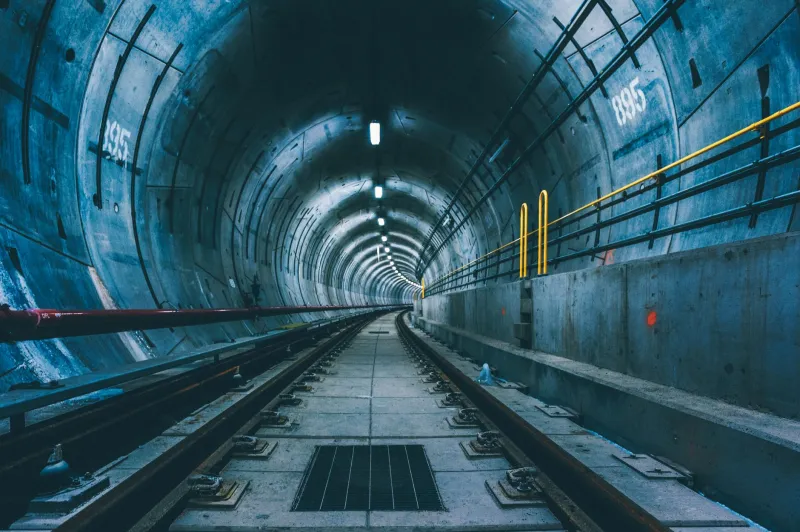
A Signal's Worst Nightmare
Aboveground, a GPS receiver is a relatively uncomplicated instrument. It listens to a constellation of satellites, compares the arrival times of their signals, and triangulates a position with impressive accuracy. The geometry is clean, the signal paths are largely unobstructed, and the physics cooperate. Descend thirty feet into a subway tunnel, however, and that cooperative relationship disintegrates almost instantly.
The problem is not simply that satellite signals cannot penetrate rock and reinforced concrete — though they largely cannot. The deeper engineering challenge is what happens to every electromagnetic wave that does manage to enter the tunnel environment, whether originating from cellular towers, Wi-Fi access points, or purpose-built positioning infrastructure. Inside a tunnel, waves do not travel freely. They bounce. They reflect off curved concrete walls, metallic rail infrastructure, train car exteriors, and the bodies of passengers. Each reflected copy of the original signal arrives at a receiver slightly later than the direct path version, carrying a phase offset proportional to its additional travel distance. When multiple reflected copies arrive simultaneously, their superposition produces interference patterns — some constructive, some destructive — that fluctuate unpredictably as trains move and passenger loads shift.
This phenomenon, known as multipath propagation, is not unique to subway environments. It plagues urban canyons, indoor warehouses, and dense building interiors. But the tunnel geometry concentrates and amplifies it to a degree that makes ordinary multipath mitigation strategies largely inadequate.
The Geometry of Destructive Interference
To appreciate why tunnels are so problematic, it helps to think about their physical structure as a waveguide — a confined channel that constrains electromagnetic propagation in ways that open-air environments never do. A circular or arched tunnel cross-section causes incoming waves to reflect at consistent angles, generating standing wave patterns along the tunnel's length. At certain positions within that standing wave structure, reflected signals arrive precisely out of phase with the direct signal, producing destructive interference that can reduce received signal strength by orders of magnitude. These locations are commonly called dead zones, and in a busy transit corridor, they are not static. They shift as signal frequencies drift, as trains alter the tunnel's effective cross-section, and as the dielectric properties of the air change with humidity and temperature.
For a GPS-dependent system, this is catastrophic. Position error accumulates when the receiver mistakes a reflected signal for a direct one, because the additional path length translates directly into a falsely inflated distance estimate. A signal that traveled an extra thirty meters before reaching the antenna will make the receiver believe the corresponding satellite is ten nanoseconds farther away than it actually is — an error that propagates into the final position calculation as a lateral offset of several meters or more. In a tunnel corridor only a few meters wide, that margin of error is operationally meaningless.
Cellular networks face analogous difficulties. The same reflective geometry that corrupts positioning data also creates amplitude-fading patterns across the frequency bands that LTE and 5G systems rely upon. A rider attempting to stream data or complete a voice call in a tunnel may experience service that oscillates between functional and completely absent within a span of seconds, driven not by network congestion but by the destructive interference pattern their device happens to occupy at that moment.
What Transit Authorities Are Actually Doing
The standard industry response to tunnel signal loss has historically been the leaky coaxial cable, sometimes called a radiating cable. These specialized cables are routed along tunnel walls and designed to emit and receive RF energy along their entire length, effectively transforming the tunnel into a distributed antenna system. The approach works reasonably well for cellular coverage but does not resolve the fundamental multipath problem for precision positioning, because the leaky cable itself becomes a source of multiple signal paths.
More sophisticated deployments are now incorporating distributed antenna systems (DAS) with tightly controlled power levels and antenna spacing calibrated to minimize the overlap between adjacent coverage zones. By limiting the spatial extent of each antenna's coverage footprint, engineers can reduce the number of reflected copies that arrive at any given receiver from a single source. The interference pattern becomes simpler and more predictable, which makes it easier for receiver-side algorithms to identify and suppress multipath artifacts.
Several major North American transit agencies, including those serving New York, Chicago, and Washington, D.C., have piloted localized mesh network architectures that treat positioning as a cooperative problem. In these systems, fixed reference nodes with precisely known locations broadcast timing signals that mobile receivers — whether in passenger devices or onboard train computers — use to compute relative positions through time-difference-of-arrival calculations. Because all nodes in the mesh share the same tunnel environment, the interference patterns affecting one node are correlated with those affecting its neighbors. That correlation can be exploited algorithmically to cancel common-mode multipath errors in a manner loosely analogous to how noise-canceling headphones use anti-phase audio to suppress ambient sound.
Emerging Approaches at the Signal Processing Layer
Beyond infrastructure changes, significant research effort is being directed at receiver-side signal processing techniques that can function reliably in high-multipath environments. Angle-of-arrival estimation, when combined with phased array antennas small enough to integrate into tunnel-mounted hardware, allows a receiver to distinguish the angular direction of incoming signals. A direct path signal and its reflected copy arrive from different directions; by resolving that angular separation, the system can weight the direct path signal more heavily in its position calculation.
Machine learning approaches are also gaining traction. Tunnel environments, while chaotic in their interference patterns, are not entirely random. The geometry is fixed, the dominant reflection surfaces are known, and the range of operating conditions is bounded. Neural networks trained on empirical signal data collected across a range of tunnel configurations have demonstrated an ability to recognize characteristic multipath signatures and compensate for them in near real time. The challenge is ensuring that these models generalize across varying train occupancy levels and infrastructure changes without requiring continuous retraining.
Ultra-wideband (UWB) radio, which has found commercial traction in applications like Apple's AirTag and precision indoor positioning systems, is attracting attention as a tunnel positioning technology precisely because its broad frequency bandwidth makes it more resistant to narrow-band fading. When a destructive interference null eliminates signal energy at one frequency, UWB systems can recover position information from the remaining bandwidth. The physics do not disappear, but they become more manageable.
The Interference Problem as an Infrastructure Problem
What the subway positioning challenge ultimately illustrates is that electromagnetic interference is not merely a technical inconvenience to be patched at the software layer. It is a structural consequence of deploying wave-based technologies inside geometries they were never designed to inhabit. The confined, reflective architecture of a transit tunnel is, from a wave physics standpoint, an adversarial environment — one that systematically transforms useful signal energy into a superposition of corrupted copies.
Solving it requires engagement at every level of the signal chain simultaneously: antenna placement, power management, frequency selection, receiver architecture, and algorithmic post-processing. No single intervention is sufficient. Transit systems that have achieved reliable underground positioning have done so by treating the interference pattern itself as a design parameter — something to be characterized, modeled, and ultimately incorporated into the system architecture rather than ignored.
For the millions of commuters who rely on real-time transit apps to navigate underground networks across the United States, the practical stakes are obvious. For the engineers working to meet that expectation, the physics of wave interference in confined spaces remains one of the more demanding problems in applied electromagnetics — and one that grows more urgent as transit authorities pursue increasingly automated and data-dependent operations.