Harmonic Ruin: The Resonance Interference Dynamics Quietly Dismantling Modern Wind Turbines
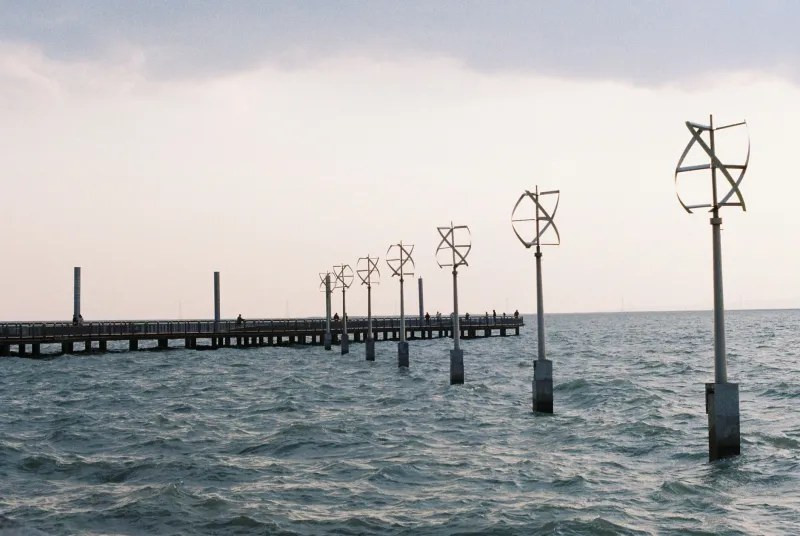
The offshore wind farm sits thirty miles from the Virginia coast, its turbines rising from the Atlantic like a geometric forest. On paper, each tower was engineered to withstand decades of sustained loading. In practice, several units have already exhibited unexpected structural anomalies — hairline fractures in blade roots, unusual tower sway signatures, and gearbox failures arriving years ahead of projected maintenance windows. The engineers responsible are not dealing with a materials problem. They are dealing with a wave problem.
The interference dynamics now undermining modern wind infrastructure represent one of the more consequential — and underappreciated — physics challenges in renewable energy engineering. When the oscillatory energy introduced by turbulent wind fields aligns, even momentarily, with the natural resonance frequencies of turbine structures, the resulting constructive interference does not merely add stress. It multiplies it in ways that standard fatigue models are poorly equipped to predict.
The Mechanics of Unwanted Amplification
Every physical structure has resonance frequencies — characteristic rates at which it will oscillate most readily when excited by an external force. For a wind turbine, these frequencies emerge from the interplay of tower height, nacelle mass, blade geometry, and foundation stiffness. Engineers refer to the lowest resonance mode as the first natural frequency, and they spend considerable effort ensuring that operational rotor speeds do not coincide with it.
The problem is that turbulent wind is not a single-frequency excitation. It is a broadband signal, a superposition of countless oscillatory components spanning a wide spectral range. When the turbulent wind field is analyzed using Fourier decomposition, it reveals energy at frequencies that can drift, intermittently, into precise alignment with a turbine's structural resonance bands. At those moments, the system experiences constructive interference: the incoming oscillatory forcing and the structure's own vibrational response reinforce one another, producing amplitude growth that neither signal alone would generate.
This is not a theoretical abstraction. Field measurements from onshore turbines in the Great Plains have documented tower oscillation amplitudes spiking by factors of three to five during brief but recurrent periods of coherent excitation — intervals when the turbulent inflow spectrum momentarily concentrates energy near the structure's first or second natural frequency. Each such event deposits stress into the material that cumulative fatigue models, calibrated against smooth spectral assumptions, fail to fully account for.
Offshore Conditions as Interference Amplifiers
The challenge intensifies dramatically in offshore environments, and this matters enormously given the United States' accelerating investment in Atlantic and Gulf Coast wind development. Offshore turbines are taller, heavier, and mounted on foundations — monopiles, jackets, or floating platforms — that introduce their own resonance characteristics into the coupled system.
Wave loading adds a second interference layer. Ocean surface waves exert periodic forcing on submerged foundations at frequencies that overlap, under certain sea states, with both the tower's structural resonance and the rotor's rotational harmonics. The result is a three-way interference environment: wind turbulence, wave periodicity, and structural resonance, each contributing oscillatory energy, each capable of constructive alignment with the others.
Researchers at the National Renewable Energy Laboratory have documented what they term "multi-source resonance coupling" in monopile-mounted turbines, a condition in which wave and wind excitations simultaneously approach structural resonance bands, producing loading amplitudes that exceed design envelope assumptions by margins that are difficult to dismiss as conservative uncertainty. The interference is not constant — it is episodic, storm-correlated, and therefore statistically underweighted in design standards that emphasize average loading rather than peak interference events.
Where Current Standards Fall Short
The IEC 61400 series, the dominant international standard governing wind turbine design, requires that engineers analyze turbine loading across a defined set of design load cases. These cases include turbulent inflow conditions, but they are typically evaluated using statistical wind field models — synthetic representations of turbulence that approximate real-world spectra without fully reproducing their most destructive interference-prone configurations.
The core limitation is spectral fidelity. Real atmospheric turbulence, particularly in complex terrain or near coastal transition zones, can exhibit coherence structures — spatially and temporally correlated gusts — that standard models underrepresent. When coherent turbulence patches sweep across a rotor, they excite the structure with a degree of spectral concentration that pushes the system closer to resonance conditions than random turbulence would. The interference potential is higher, and the resulting fatigue damage accumulates faster.
Several engineering firms working on next-generation offshore projects have begun advocating for physics-based turbulence models that preserve these coherence properties, but adoption remains inconsistent across the industry. The computational cost of high-fidelity aeroelastic simulations that capture multi-source interference is substantial, and the commercial pressure to minimize design margins in competitive procurement environments does not favor conservatism.
Emerging Mitigation Strategies
The engineering response to resonance interference in wind turbines is developing along several parallel tracks. Structural detuning — deliberately shifting a turbine's natural frequencies away from known excitation bands — remains the most straightforward approach. This can be achieved through foundation stiffness tuning, mass distribution adjustments, or damping augmentation via tuned mass dampers installed within the tower.
Active control strategies are gaining traction as well. Modern turbine controllers can modulate rotor speed and blade pitch to reduce the spectral energy delivered to the structure at resonance-prone frequencies. This is, in effect, an interference cancellation strategy: the controller introduces counteracting forcing to suppress the buildup of resonant amplitude, analogous in principle to the anti-phase engineering used in active noise cancellation systems.
Sensor-informed structural health monitoring is also becoming a standard design element in premium offshore installations. Accelerometers and strain gauges distributed across tower and blade structures feed real-time data into algorithms that detect early signatures of resonance buildup, enabling operators to adjust operational parameters before interference-driven stress accumulates to critical levels.
The Broader Implication for Renewable Infrastructure
The United States has committed to deploying 30 gigawatts of offshore wind capacity by 2030. The capital investment involved is measured in hundreds of billions of dollars. If the interference dynamics described here remain systematically underestimated in design standards, the consequence will not be catastrophic structural collapse in most cases — it will be accelerated degradation, shortened asset lifespans, and maintenance costs that erode the economic viability of projects that were already operating on thin margins.
The resonance trap is not a new physics problem. Engineers have understood structural resonance for well over a century. What is new is the scale, the environmental complexity, and the economic stakes involved in deploying massive rotating structures into some of the most turbulence-rich, wave-active environments on the planet. The wave physics has not changed. The engineering community's accounting of it must.