Phase-Locking in the Dark: What Firefly Swarms Teach Engineers About Collision-Free Wireless Networks
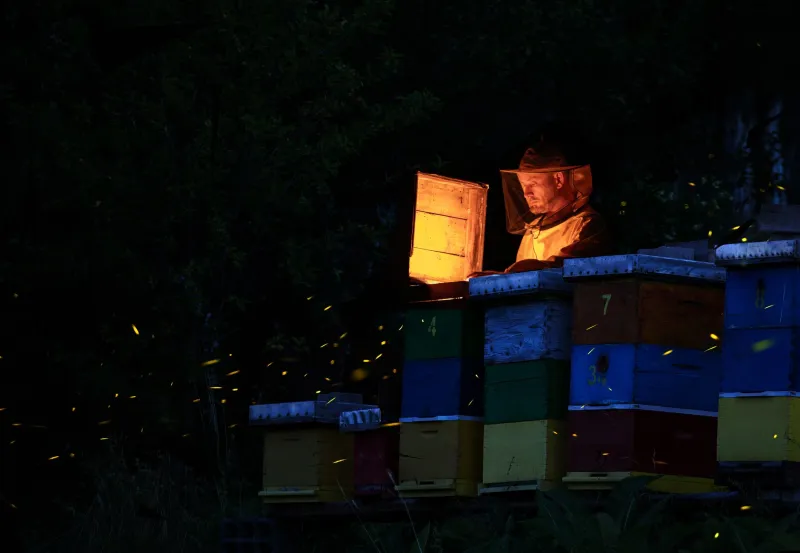
Every summer along the ridgelines of the Great Smoky Mountains National Park, a phenomenon unfolds that has captivated both tourists and theoretical biologists for decades. Thousands of Photinus carolinus fireflies begin their evening display in apparent chaos — individual insects blinking at their own rhythms, out of phase with every neighbor. Within minutes, however, the forest canopy transforms. The flashes converge. A single coherent pulse propagates through the swarm, thousands of light sources firing in near-perfect unison, then falling silent together, then firing again. No conductor. No central clock. No master transmitter.
What the fireflies have solved, without the benefit of engineering degrees, is one of the most vexing interference problems in modern wireless communication: how to coordinate the transmission timing of a large population of independent nodes so that their signals reinforce rather than collide.
The Interference Problem That Scales Badly
In wireless sensor networks — the dense grids of low-power transceivers that underpin smart infrastructure, precision agriculture, and industrial IoT — destructive interference is not a theoretical concern. It is a daily operational failure. When two nodes transmit simultaneously on the same channel, their signals overlap at the receiver. Depending on their relative phases, the superposition can partially or fully cancel the intended information, producing packet loss rates that degrade network reliability in ways that scale nonlinearly with node density.
Conventional remedies fall into two broad families. Contention-based protocols such as CSMA/CA instruct nodes to listen before transmitting and to back off for a randomized interval when the channel is busy. Time-division schemes assign each node a dedicated transmission slot within a synchronized frame. Both approaches impose overhead — either in wasted airtime or in the energy and infrastructure cost of maintaining a shared clock. Neither scales gracefully to the dense, heterogeneous, energy-constrained networks that characterize next-generation IoT deployments. The deeper problem is architectural: both solutions attempt to suppress interference after the fact rather than preventing the phase conditions that generate it.
Fireflies, it turns out, take the second approach — but they do it through local interaction rather than central authority.
Coupled Oscillators and the Mathematics of Mutual Entrainment
The biological mechanism behind firefly synchronization is best understood through the framework of coupled oscillators, a branch of dynamical systems theory formalized in part by mathematician Yoshiki Kuramoto in the 1970s. Each firefly maintains an internal oscillator — a biochemical pacemaker in its lantern organ — that drives flash production at a species-specific natural frequency. In P. carolinus, this period is approximately 0.5 seconds between flashes under typical conditions.
Critically, each firefly also perceives the flashes of its neighbors and adjusts its own phase in response. The adjustment rule is asymmetric: upon observing a neighbor's flash, the firefly advances its own oscillator phase slightly if the neighbor fired ahead of it, and does nothing — or advances marginally less — if the neighbor fired behind it. This is a phase-response curve, and its asymmetry is the key to synchronization. The rule causes each oscillator to continuously "lean toward" the phase of its local neighborhood, producing a gradual convergence that propagates outward through the swarm like a wave of mutual entrainment.
The result is global coherence emerging from purely local rules — what complexity theorists would recognize as a self-organizing system. No firefly has knowledge of the swarm's overall state. Each responds only to the signals it can directly perceive, yet the collective outcome is a synchronized broadcast that eliminates the phase dispersion responsible for interference.
Reverse-Engineering the Algorithm
Engineers have been attempting to translate this biological logic into protocol design since at least the early 2000s, when researchers at Georgia Tech and Bell Labs began publishing formal analyses of firefly-inspired synchronization algorithms. The general approach involves equipping each network node with a virtual oscillator — a software counter that increments continuously and triggers a transmission (or a synchronization beacon) when it reaches a threshold. Upon receiving a transmission from a neighbor, the node applies a phase-response update analogous to the firefly's biochemical adjustment: it shifts its own counter forward or backward by a small, rule-governed increment.
Early implementations demonstrated that even simplified versions of this mechanism — sometimes called Pulse-Coupled Oscillator (PCO) protocols — could drive a population of unsynchronized nodes into phase-locked coherence within a small number of oscillation cycles, without any external time reference. The convergence time scales favorably with network size under certain coupling conditions, a property that purely randomized back-off schemes cannot match.
More recent work has focused on the robustness of these algorithms under realistic channel conditions. Wireless channels are not the clean optical medium of a forest clearing. Multipath fading, hidden-node problems, and asymmetric link quality all perturb the phase-update process. Researchers at MIT Lincoln Laboratory and at several university groups funded through NSF's Cyber-Physical Systems program have developed modified PCO protocols that incorporate noise-tolerant phase estimators and adaptive coupling strengths, allowing the synchronization process to remain stable even when a significant fraction of inter-node signals are lost or corrupted.
Applications Where Biological Timing Precision Matters Most
The practical stakes of this research are considerable in at least three application domains.
In emergency mesh networks — the kind deployed after hurricanes disable fixed infrastructure, a recurring scenario along the Gulf Coast and in Puerto Rico — centralized synchronization infrastructure is by definition unavailable. Firefly-inspired PCO protocols offer a pathway to self-organizing communication grids that achieve channel coordination without relying on GPS timing signals or dedicated synchronization servers, both of which are vulnerable to the same disasters that necessitate the network.
In distributed structural health monitoring, arrays of vibration and strain sensors embedded in bridges, pipelines, and building frames must coordinate their sampling windows to capture coherent snapshots of structural dynamics. Phase misalignment between nodes introduces artifacts that mimic — or mask — the very stress signatures engineers are trying to detect. PCO-based coordination has been shown in laboratory demonstrations to reduce inter-node timing jitter to levels below the threshold at which such artifacts appear.
In dense industrial IoT, particularly in manufacturing environments where hundreds of sensors share a congested 2.4 GHz band, the collision rates generated by conventional MAC protocols impose latency penalties that make real-time process control unreliable. Synchronization algorithms derived from firefly dynamics have demonstrated packet delivery improvements of 30 to 40 percent over CSMA/CA baselines in simulation studies, with the advantage growing as node density increases.
The Limits of the Analogy
It would be a misrepresentation to suggest that the engineering problem is solved. Firefly synchronization operates in a medium — open air, with line-of-sight optical signaling — that is far more forgiving than the cluttered radio environments in which IoT networks operate. The phase-response curves that work elegantly in P. carolinus populations require careful re-parameterization for wireless channels, and the optimal parameters are environment-dependent in ways that demand ongoing adaptation.
There is also the question of heterogeneity. A firefly swarm consists of nodes with nearly identical natural frequencies and coupling behaviors. Real sensor networks mix devices from different manufacturers, running different firmware, with different clock drift characteristics. Extending PCO convergence guarantees to heterogeneous populations remains an open research problem.
Nevertheless, the conceptual contribution of the biological model is substantial. The fireflies of the Smokies do not merely offer an elegant metaphor. They demonstrate, in operational hardware refined over millions of years of selection pressure, that large populations of independent oscillators can achieve the kind of phase coherence that eliminates destructive interference — and they do so through a mechanism that is, at its mathematical core, directly translatable into network protocol design.
In the study of wave phenomena, nature has always been ahead of the engineering literature. The firefly swarm is simply one of its more visually persuasive proofs of concept.